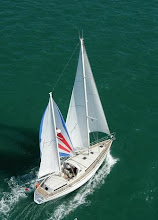
Sunday, February 27, 2011

Marie Galante

We haven’t been to this small round island before simply because it ment sailing East against the wind. For the same reason the bays there are not overcrowded with sailboats.
We anchored in the Grand Bourg Bay and stayed there four days, shared a rented car with ‘LAIMA’ crew and toured the island.
Marie Galante is self sufficient. High tech windmills produce electricity; we drove by solar panel fields; cattle everywhere. The island is neat, countryside and the towns are clean, no plastic bags and empty bottles caught in the shrubs. People are well dressed.
The main crop is sugar cane, that used to be ground by 600 sail driven windmills. Le Moulin de Bezard has been restored to crush cane for visitors. In spite of today’s modern technology, ox drawn carts still haul the cane.


Two Carib beauties


A Carib beauty


Marie Galante solar energy


Old mill built in 1814


Local market


Beau


Sink hole 'Gueule Grand Gouffre'


The contrast of times


Baguettes


Grand Bourg

Friday, February 18, 2011

Dominica

Roseau, the Capital of Dominica, sheltered by high hills

We always enjoy the dolphins' company

Dominica's tooth

Our friends Majda and Peter left for their winter home Slovenia from le Mitan, where we met again the ‘LAIMA’ team Beni, Rick and their furry friend Katie. Together we sailed North to Dominica with a stop in Roseau and then Portsmouth in Prince Rupert Bay. We have been on this picturesque and friendly island before and took an Indian River tour through the jungle. This time we just rested and enjoyed the views from our sailboat.
In the Prince Rupert Bay our propeller got tangled in an abandoned anchor line. One of to many vendor boys took his close off and swam under the boat holding the knife in his teeth. I don’t know what was more exciting, his Tarzan maneuver or his body parts (Sorry, no picture).


Thursday, February 3, 2011

Anse D'Arlet


Trunk fish, that swam away happy


Another day in paradize

Sailing South from Fort de France, passing Grand Anse D'Arlet, we turned into the bay with a charming village Anse D'Arlet. A lovely church stands in the center, paved boardwalk separating it from the coast. Long afternoon siesta is proving a laserly life here. In the evening the owner of the small grosery store is sitting on the bench enjoying a cool breeze from the sea. If you need to buy something, you will start a friendly conversation with her and then she will slowly walk across the street to the store and sell you a baguette, fresh any time of the day.

In the evening we went for a walk and stopped at the fish market, fully stocked. The village is small with only a couple of restaurants and a resort, I wonder, what do fishermen do with the leftover fish.

We found the rocky sides of the bay, that surrounded the beach, one of the best snorkeling sites with many different corals all colors and shapes.

The only resort is taking the best spot on the beach, but doesn't own it.

On sunday, the beach fills up with the families from the town, lunches are spread out of the coolers, laughter is everywhere. Young couples are leaning against each other, burying their feet into the hot sand. Small local boats, over loaded with teenagers, are buzzing through the bay.
The beach is quiet again on Monday, tourists from the resort, a day or two redder, are back on the lounche chairs, pretending to read. Puffy clouds touching the blue sea on the Horizon are
distructing them.
We feel lucky. We don't have to go home tomorrow or the day after.


Wednesday, February 2, 2011

St.Pierre, Martinique

With our Slovene friends Majda and Peter, sailing with us from Le Marin, we chose the next destination to be St. Pierre.
Crossing the Baie de Fort de France in wind gusts is always exciting and this time was no exception. We slowed down as Martinique sheltered us and had barely enough wind to sail to St. Pierre without motoring.
The Paris of the Caribbean until 1902, when St. Pierre, the commercial, cultural and social center of Martinique with population of 30.ooo, was burned by lava, gasses, mud and rocks. Two people survived the eruption of Mt. Pelee volcano, the cobler working in his cellar and a prisoner in a stone cell.
Twelve ships anchored in the bay were also distroyed.
St. Pierre was rebuilt, but somr ruins remain. There is also a museum telling the tragic story.

Majda and Peter


Mt. Pelee


The tomb burned in the eruption of 1902


Typical Caribbean cemetery


Bamboo roof


Bishop's mansion

St. Pierre cathedral


St. Pierre cathedral


Tough life


'NADA' in yet another sunset


Wednesday, January 5, 2011

Anse Mitan

The detail of Anse Mitan


Going North from Anse D’Arlet, passing Grand Anse D’Arlet and Anse L’Ane, we sailed into Baie de Fort de France and anchored on the South side of it by Le Mitan. We couldn’t get provisions here, the grocery store was almost empty, except for the wine and baguettes. But you would not get hungry in this town with many restaurants and pastry shops.
We anchored in front of a resort and walk to the town Le Mitan through it’s beautiful garden, but we couldn’t use the hotel’s Internet. We connected in a nearby restaurant, where we ordered drinks. More drinks, more Internet time.
From Le Mitan you can catch a ferry every hour to the Capital of Martinique, Fort de France, where one fourth of 400,000 Martinique population found their homes. A mix of modern and old Creole, the city is a working place with many businesses and stores, lively during the day and quiet at night.

Monday, January 3, 2011

Martinique

The tip of Martinique with the Diamond Rock in a sunset


We are on Martinique, Caribs called it Madinina – the island of flowers. It is richly cultivated with banana and pineapple plantations and fields of sugar cane.

You can have breakfast at the French pastry shop and then browse through many charming or elegant stores.

In the cool of the afternoon you would want to visit small squares, surrounded by the flowering bushes, where guillotine was to often used, and pay respect to the victims of time.

Except for a few short periods of British power, French took over the island after killing the Arawaks, who colonized the island over 2000 years ago and fought the newcomers, choosing death over slavery.

The Martinique main road runs along the shore and when you tour the island, spectacular views make you stop and enjoy the unspoiled nature, the contrast of color, the scent of blooming oleanders, the laziness of a hot day and the wildness of the sea, brushing over the coral reefs.

Tuesday, November 9, 2010

Afloat

Reduit Beach life


'NADA' was launched on Friday, the 5th of November and we anchored in the clean water in front of the Reduit Beach.
We picked up the repaired genoa, the dodger is still in the works.
The big Atlantic surf is rocking us slowly. We could move to better sheltered area and risk loosing the Internet connection.
With not much hope I tried to fish at night. We are to close to the sandy shore and to far from the rocks.
Once a day we dinghy to the village to stretch our legs and to get supplies.
There is still no running water on St. Lucia, to repair the collapsed dam will take another month, we were told. The bridges were rebuilt to connect Rodney Bay with the Capital Castries and other towns. Life goes on.